Showing posts with label car seats. Show all posts

Friday, March 23, 2012

The kids' health and safety in China

By far the biggest challenge during our trip to China was ensuring that the kids (the two outside ones and the one inside, too) stayed healthy and safe. To be honest, I didn't even really research much about this topic ahead of time. In retrospect, this was probably a good thing, because it turns out there were a lot of considerations, and I might have gotten scared off from doing the trip at all :) I will say that I'm very glad that we went and would do it again in a heartbeat, even knowing what I know now. So keep that in mind as you read the rest of this post…

Water
Drinking tap water in China is not recommended. We used bottled water for drinking, cooking (the service apartment that we stayed in for most of our time in China had a small kitchen), and teeth brushing. We did use tap water for bathing, hand washing, and dish washing.

Bottled water is cheap to buy, and hotels also provide bottled water. In the service apartment, the room had a water dispenser (like a water cooler that you might see in an office in the USA). A big bottle of water for the dispenser cost about $2 and lasted for 3-4 days.

Littles is old enough now to get her own cup of water, so we had to make sure that she knew to always get water from the dispenser, not the sink like she does at home.

Food
I've never been so thankful for the FDA. Say what you will about it and its regulatory teeth (or lack thereof), but at least in the USA, I have some degree of confidence that 1) food is generally produced in a safe manner and 2) if there is a food safety problem, it will be publicized (in a language I can understand) and addressed appropriately.

I had no such reassurances in China. Milk has been tainted with chemicals, produce has been grown using human feces as fertilizer, etc. Since we were doing a lot of our own cooking, we did most of our food shopping at Western grocery stores, rather than Chinese markets. Much of the food there was imported, which meant that the prices were (significantly) higher, but we had more reassurance that the food had been produced under safe conditions. When eating out, we just used common sense, and stuck to restaurants that came recommended or otherwise seemed reputable.

As in most places where you can't drink the water, eating raw fruits/vegetables isn't recommended either, since they may have been washed in tap water. Even if you wash them yourself, they could have come into contact with bacteria that water won't get off. I was really careful about this, since I had Q to worry about -- some bacteria can have little/no effect on a healthy person, but can greatly affect a fetus. The others were slightly more lax, and were fine (for the most part). As much as possible, I did try to get fruits/vegetables with a peel for the kids to snack on (bananas, kiwi, oranges, even stuff like apples or carrots) so that I could take the peel, and hopefully any bacteria, off before eating it.

Unlike many places where you can't drink the water, ice in restaurants isn't a concern. For starters, it's rare to get water in restaurants (tea is offered as the drink of choice), and if you do, it's usually warm (apparently, the Chinese believe that cold water is not good for you). But restaurants that do offer ice usually make it out of boiled or filtered water.

Food allergies
Noob is allergic to peanuts, and Chinese dishes often have peanuts in them. We steered clear of restaurants that didn't have English translations for their menus, to avoid accidentally ordering a peanut-containing dish. Sometimes, this meant choosing a less-desirable restaurant option, like the time that we needed a quick meal and we chose McDonald's over a Chinese fast food place that had a Chinese-only menu. But I'd take a McDonald's meal any day over a trip to the hospital to treat anaphylactic shock.

Car safety
Things I learned about cars and driving in China:

  • American driver licenses are not valid in China, so we needed to take a taxi or hire a car/driver whenever we needed to drive somewhere.
  • LATCH (or ISOFIX) seems to be completely non-existent. This meant that Littles’ Go Hybrid Booster could only be used as a booster, not as a harnessed seat.
  • The seat belts I saw did not have the auto lockoff capability that is common on cars sold in America. This meant that I had to use the built-in lockoffs on Noob’s convertible seat when installing it using the seatbelt (which was, of course, my only option, since LATCH wasn’t available).
  • Many taxis have a cover over the back seat that prevents you from accessing the seatbelt entirely, making it impossible to secure a car seat.
  • There are no car seat laws in China, so you won’t get arrested for not putting your child in a car seat. Of course, if you get in an accident, the laws of physics (specifically how they relate to unrestrained children in cars) still apply…
  • And just FYI, emergency services are not as reliable in China as they are in the USA. We went out to dinner one night with some of my husband’s Chinese co-workers and passed an accident on the way. I asked the Chinese about how long an ambulance would take to arrive. They laughed. “Oh, maybe an hour? Maybe more?”

Due to all of this, we took public transportation whenever possible. We found the subway systems in both Shanghai and Beijing to be very cheap, convenient, reliable, and safe. And no concerns about waiting an hour for an ambulance after my unrestrained child went flying through the windshield.

Pedestrian safety
As scary as driving was, sometimes walking around didn’t seem much better :)

  • We had to be heads-up at all times while walking on the sidewalk. There were tons of little motorized scooters that drove at relatively high speeds on the sidewalks, and sometimes the random car decided to hop up on the sidewalk as well. We had to keep a close eye on Littles, in particular. (Noob was usually on my back in the Ergo, so he was less apt to wander into the path of an oncoming scooter.
  • Red traffic lights seemed to be treated as a gentle suggestion to stop :) Even with pedestrians waiting to cross the street – or actually in the process of crossing the street. This was especially true of the motorized scooters, as well as bicycles. I usually tried to hide behind a couple of other pedestrians crossing the road, figuring the cars/scooters/bikes would hit them first!
  • The subways could be very crowded at times, with lots of pushing, and people weren’t always aware of the kids. The Ergo really came in handy, as it prevented us from having to deal with a stroller, and put Noob more at adult eye level. But we had to make sure one of us always kept a firm grip on Littles’ hand when boarding/disembarking, to prevent her from getting lost in the crowds, and sometimes we had to keep her from getting totally squished.

Despite all that… we all survived! We just had to be a little more careful about things than we do back home.

Tuesday, August 9, 2011

Top kid travel gear: Safety First Go Hybrid Booster

GoHybrid

When Noob outgrew his infant car seat last December, we opted to move him into Littles' old convertible seats, and purchase new seats for Littles. I selected two seats that convert from forward-facing 5-point harness seats into belt positioning booster seats as the child grows. In Hubby's car, Littles sits in a Graco Nautilus, and in my car, a Safety First Go Hybrid Booster. Both seats are our everyday car seats at home, but I chose the Go Hybrid specifically with an eye towards traveling as well. Our recent trip to Panama was our first opportunity to see how the Go Hybrid performed on the road.

The Basics
The Go Hybrid provides a forward-facing 5-point harness for children who are at least 1 year old and between 22-65 lbs. It does not rear face, so I do not recommend it for children under age 2, per the AAP's recently revised car seat usage guidelines. Hence why Noob doesn't use this seat.

It also converts to a backless booster for children who are at least 3 years old and between 40-100 lbs. Again, remember that just because you can use it as a booster does not mean that you should. Please review this information to determine whether your child is ready for a booster seat. Littles is 4 years old and just shy of 40 lbs right now, and I have zero plans to convert this seat to a booster anytime soon.

I also want to call out that the Go Hybrid does not convert to a high back booster, only to a backless booster. There is some great information about the safety of each type of booster here. High back boosters are considered to be a little safer, but I’m not too worried about this. When the time comes to move Littles out of the harness, if I’m not comfortable with her being in a backless booster, I figure we’ll move Noob into the Go Hybrid’s harness, and buy a new high back booster for Littles. High back boosters are much cheaper and lighter than regular car seats, so this should be a very workable solution both at home and while traveling.

There is detailed information on this seat’s limits and measurements at car-seat.org.

Design
The seat has a unique design with a soft, flexible back. Because of this feature, it is very light, weighing in at around 8 lbs, and it also can fold up to be just a little larger than the base. This makes it an excellent seat for for traveling! It even comes with a handy (although somewhat thin) travel bag. Here is Littles' Go Hybrid in its travel bag:

IMG_6691

Also because of this flexible back, the seat requires a LATCH top tether. It is unusable without it. Ironically, that means that this fabulous travel seat is not usable on an airplane! This is fine for our purposes, because Littles has not used a car seat on an airplane in nearly two years anyway. (If you like the Go Hybrid for the car but want protection on the airplane too, check out the CARES harness, which will provide compact and lightweight protection while in flight.)

At home
The Go Hybrid has been Littles' seat in my 2007 Honda Fit Sport for about seven months now, and I love it. Installation was a breeze when using LATCH. I did try a seatbelt install, and could not get it tight enough to be safe no matter what I tried, so I've stuck with LATCH.

(As a side note, LATCH anchors are typically stated to have an upper weight limit of 48 lbs -- check your car manual to confirm. This is based on a child-plus-car-seat weight of 68 lbs and the assumption that the average car seat weighs around 20 lbs. Since the Go Hybrid is much lighter, it can safely be used with LATCH anchors with a child weighing up to 60 lbs.)

The Go Hybrid works great as an everyday seat. The harness is a little unique in that it is tightened on either side of the child's legs, rather than in the middle, as most seats do. But it's easy to use once you get used to it, and I find that I have a lot fewer problems with twisted straps in this seat vs. our other seats. Her preschool does a car line drop-off, and the various teachers who come to get her each morning never have any trouble with the harness. I also love that it's an "infinite adjust" harness, so I don't have to take the seat out of the car to adjust the harness height.

The seat does not have a lot of padding, and on the rare occasions when Littles does sleep in the car, her head slumps in a way that doesn't seem comfortable at all:

7e (2)
At home, June 2011 (almost 4 years old)

But I should note that the head-slump thing happens in the Graco Nautilus, too. And for the record, Littles has never complained about comfort. She seems to really like this seat. In particular, she loves that the low-profile design puts her closer to the actual car seat, so she's able to reach her books, toys, etc. It really looks more like a "big kid" booster seat than a "little baby" convertible seat, so it's a great way to keep older kids harnessed longer!

On the road
But there are lots of seats that work great for everyday usage. What really sets the Go Hybrid apart is how well it works while traveling.

Because the seat folds up so small, it was a breeze to travel with. We were able to place it on top of one of our large rolling suitcases when walking around the airport. This was fantastic, as it meant that Littles' car seat didn't "use up" one of our hands. One person could handle one large suitcase, Noob’s car seat on the GoGo Kidz Travelmate, and the Go Hybrid. The other person could handle two more large suitcases. Had we used a regular car seat for Littles (on a Travelmate, of course), we would have had to leave one suitcase – and some of our stuff! – back at home.

The downsides of the Go Hybrid? The reliance on LATCH proved to be a little bit of a pain. Our cab driver at the Miami airport got pretty annoyed with us because it took a while to find the LATCH anchors and tethers in the unfamiliar car.

Also, not every car comes with LATCH (or ISOFIX, as it's called in many other countries). If you're renting a car in the USA, you shouldn't have any problems, but if you're traveling internationally or if you'll be driving with a friend who might have an older car, you should confirm that LATCH will be available.

Also, due to the soft back, the Go Hybrid must be installed in a seat that has a back high enough to support it, when used in harness mode. That is, when your child is seated in the Go Hybrid, the car seat's back plus the headrest (if available) must be at least as high as your child's head. We didn't have any problems with that on this trip, but it's something to look out for, especially when using this seat with taller children.

The verdict
I love this seat and highly recommend it! It is a wonderful everyday seat, and the fact that it works so well while traveling is simply icing on the cake. This is hands-down the best car seat I've seen for traveling, as long as you're confident that you'll have LATCH at your destination.

Friday, March 18, 2011

Top kid travel gear: Cosco Scenera car seat


Littles snoozing in the Scenera at Flagg Ranch, Yellowstone National Park (15 months old)

This post is part of a series on top kid travel gear.

Funny, we actually did not purchase our Cosco Scenera car seat with the intention of using it while traveling. We bought it when Littles was about 1 year old to leave with her sitter/nanny, so that she could drive Littles during the day while she watched her. We chose it because it is cheap (about $40 at Walmart) and gets great safety ratings.

But as it turns out, it's a perfect travel seat as well. It is lightweight, so it is easy to drag around the airport. It is narrow, so it fits easily in airline seats. It comes with its own handy bag for travel. And since it's cheap, I never worry about it getting lost or damaged while in transit. If that does happen, it will be no big deal to just buy a new one!

The Scenera does rear-facing from 5-35 lbs and forward-facing from 22-40 lbs. Littles still fits easily into the seat at 3.5 years old.

Downsides? There are a few:

  1. The straps get twisted and stuck much more easily than on the more-expensive Britax seats that we use in our own cars. It's a bit of a pain, which is why we don't use the Scenera as our everyday seat.
  2. The Scenera is less padded, although Littles has never complained about it.
  3. We've found that it requires some sort of leveler (such as a rolled-up towel or a pool noodle) when installed rear-facing in most cars. We have yet to get organized enough to carry a pool noodle with us when we travel, so we usually end up rolling up a sweatshirt or coat to get from the airport to the hotel, then borrowing a hotel towel to get the seat at the right level for the rest of the trip.
  4. While it is compatible with our older version of the GoGo Kidz Travelmate, it doesn't attach as securely as the Britax seats do. It's also not at all compatible with the newer Travelmate quick release strap.

Due to that last point, I think we'll end up traveling with the smaller of our two Britax seats (a Roundabout) on our future trips, now that we have the Travelmate quick release strap. But I sure will miss traveling with the Scenera. Having an extra seat for travel is a bit of a luxury, but it's really nice to not have to hassle with reinstalling the car seat when you arrive back home late at night and have two tired kiddos on your hands!

Wednesday, March 9, 2011

Top kid travel gear: GoGo Kidz Travelmate

This post is part of a series on top kid travel gear.

As I've written previously, we prefer to gate-check our car seats, even when we don't bring them onboard the plane, to minimize the risk of any damage issues. Unfortunately, car seats are pretty bulky and heavy, making them a royal pain to lug around the airport.

Enter the GoGo Kidz Travelmate. It's a set of wheels that attaches to a convertible car seat, allowing you to wheel the car seat around the airport. So easy!

I first bought the Travelmate back when Littles was 11 months old. We were in the process of moving from California to Texas, and had a month where Littles and I were still living in California, but Hubby had already moved to Texas. During that month, I had two trips back-to-back that I had to take alone with Littles. For the first trip, I stuck her car seat inside our full-size stroller so that I could wheel it around the airport. That worked OK, but when we got on the parking shuttle, I had to pull the car seat out of the stroller, fold up the stroller, and put the stroller and car seat on to the parking shuttle. Then I had to reverse the process upon arriving at the airport. Repeat the process and then reverse the process when clearing security. And so on. Did I mention I was also trying to keep track of a newly walking Littles through all this, not to mention all our other bags?

So, on our way to the airport for the second trip, I stopped by Babies R Us and picked up a Travelmate. It provided the same mobility as the stroller, but was much faster to set up/break down (just raise/lower the telescoping handle) and less bulky overall.

A couple of tips and quirks regarding the Travelmate:

  • We have the older version (UNIQR). The Travelmate attaches to the car seat by means of two thumbscrews.
  • There is a newer version as well (QRKIDZ), which offers a quick-release strap with a buckle, in place of the thumbscrews. GoGo Babyz sells the quick release strap separately, so we recently got one. I'll update my review of the Travelmate after we've had the chance to travel with it!
  • We have used both a Britax Roundabout and a Cosco Scenera with the Travelmate. The Roundabout attaches more securely than the Scenera does -- so it does work a little better with certain car seats. (Note: The Scenera is only compatible with the UNIQR version.)
  • The car seat + Travelmate does not fit through the x-ray machines at most airports. We ask TSA to hand-scan the whole thing, to avoid removing the Travelmate from the car seat, because with the UNIQR version, it takes some time to take it off and put it on. TSA is usually happy to comply with the hand scan request.
  • You can install the car seat + Travelmate directly into the airline seat. The orange wheels have quick releases on them, so you can quickly remove them when installing the seat and then replace them at the end of the flight. (Do not install the car seat + Travelmate in the car, as the Travelmate is not crash-tested.)
  • Once Littles got bigger, we found that it was better to remove the Travelmate from the car seat onboard the plane, because when it was attached, it put her a little bit closer to the seat in front of her for kicking purposes! Not good!
  • I wouldn't recommend using the Travelmate as a full-time stroller at your destination. For starters, it would mean removing and then reinstalling your car seat every time you wanted to use the "stroller." Also, I just don't feel like the Travelmate is sturdy enough to take the abuse that a stroller takes. It would certainly work in a pinch, but I wouldn't plan on walking for hours with your kid in it.
  • Along the same lines, I should point out that we don't typically travel with a stroller at all. We use a baby carrier (such as our Ergo) for kid-hauling duties at our destination. If we did actually need a stroller, I think we would ditch the Travelmate, and just wheel the car seat around the airport using the stroller, like we did in our pre-Travelmate days. Then we'd have it to use at our destination. But since we don't need the stroller, we're able to travel a lot lighter by relying on the Travelmate and Ergo instead.

Bottom line? We never, ever, ever fly without our Travelmate. I think it's a great investment for any family that flies frequently, especially if one parent needs to travel alone with the kid(s). That said, at $90 new, I don't usually recommend it to families that don't fly frequently, especially if they're planning to bring a stroller anyway. If you're only flying once or twice a year (or every few years!), you can probably put up with just dragging the car seat around for that trip.

Friday, January 14, 2011

To car seat or not to car seat


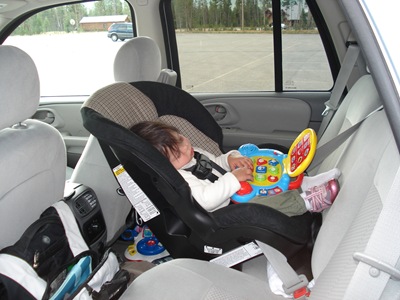
Littles snoozing in her infant seat + Snap-n-Go during a layover in Atlanta (3 months old)

Another key decision point that we make on each of our trips is around car seats. Specifically, should we bring a car seat with us? If yes, should we check it with our bags, gate check it, or bring it onboard?

The answer to the first question has always been straightforward for us: Yes! We have brought a car seat on every single one of our trips. Most of the time, we rent a car on the other end and do a significant amount of driving. Rental car companies do rent car seats, but it's usually expensive (around $10/day), they are not guaranteed to have an appropriate seat when you arrive, and the seat may be in very poor condition. It's much less stressful for us to bring our own.

Once we're at the airport, we do different things with the car seats depending on the situation. Our general rule is that car seats do not get checked with luggage. Reason being, if the car seat gets lost or damaged, we would be stuck in a strange airport with no way to transport our kid. And that would suck. (We do sometimes check it on the way home, since this is less of a concern.)

This means that we've needed an easy way to get the seat to the gate. Car seats are fairly bulky and heavy, so wheels are the way to go:


  • Littles was in her infant seat until 10 months of age. In this phase, we traveled with a Snap-n-Go stroller frame. This made it easy to navigate the airport with the car seat.

  • When she moved out of the infant seat, we initially brought our travel system stroller (Graco Metrolite) and simply stuck her convertible seat in the main part of the stroller. This was much easier than attempting to carry the car seat around the airport. It was not sturdy enough to place Littles in the car seat while we wheeled it around, but we usually had her in a baby carrier anyway. (We use an Ergo.)

  • After a few trips with this setup, we realized that we were almost never using the stroller anywhere besides the airport. So we started leaving the stroller at home, and purchased a GoGo Kidz Travelmate to attach to the car seat.

Once at the gate, we gate-checked the seat if Littles did not have a seat. But as I explained in a previous post, we opted to purchase a seat for her on every trip past 10 months of age. So when she did have a seat, we brought the car seat onboard. We found that she did really well sitting in it, probably because she was used to it from the car.

Around her second birthday, she discovered the joy of kicking the seat in front of her. Unfortunately, the car seat put her in the perfect position to do just that. She was also starting to do activities that required the use of the tray table, like color, play with Playdoh, and watch DVDs, and her car seat did not allow the tray table to fold out fully. So her last trip in the car seat was at 27 months. These days, she sits directly in the airline seat, which gives her full use of the tray table and prevents seat-kicking.

When Noob came along, he was also in the infant seat until about 10 months of age, so we pulled out the Snap-n-Go again for use with his seat. We continued to use the Travelmate for Littles' seat.

We haven't traveled yet with Noob in a convertible seat, but we plan to put him in Littles' old convertible seat, using the Travelmate. For Littles, we recently purchased a Safety First Go Hybrid Booster seat. It is super lightweight (less than 10 lbs) and folds into a small bag for travel. I think it will be a lot easier to deal with than a second convertible seat on a Travelmate! I'll be sure to post a review of it after we do travel with it for the first time.

Updated July 2011: We now travel with Noob in a convertible seat (Britax Roundabout) on the Travelmate, and Littles in a Go Hybrid booster seat. That combination is very easy to transport! Here is a link to my review of the Go Hybrid Booster.